

![[Insight] Evaporative Cooler vs Air Conditioning: What’s the Difference?](https://www.aircon.com.au/wp-content/uploads/2026/01/Blog-Banner-Template-7.png)
Evaporative Cooler vs Air Conditioning: What’s the Difference?
The key difference between an evaporative cooler and air conditioning lies in how they cool the air. An evaporative cooler cools air by using water evaporation, while air conditioning relies on a refrigeration system to actively remove heat and moisture from indoor air.
Understanding this difference is essential when choosing the most suitable cooling option for a specific climate, space type, and ventilation setup.
How Does an Evaporative Cooler Work?
Evaporative Cooling Process
Warm air enters wet pads, cools down via evaporation, and exits as fresh cool air. An evaporative cooler pulls warm air from outside and passes it through water-saturated cooling pads. As the water evaporates, it absorbs heat from the air, lowering the temperature before the cooled air is circulated into the space.
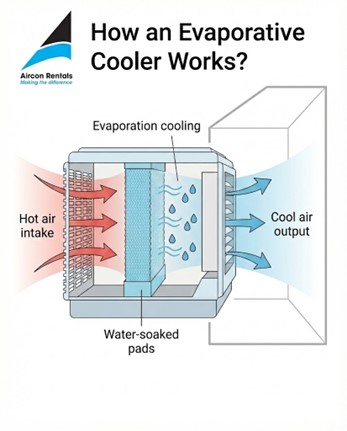
Evaporative coolers reduce air temperature by using water evaporation and require open ventilation to operate effectively.
Key features of evaporative cooling
- Relies on water, not refrigerant
- Draws in fresh outdoor air
- Increases indoor humidity
- Requires continuous airflow and ventilation
Note: Most evaporative coolers need a steady water supply and regular pad maintenance to operate efficiently and hygienically. Poor maintenance can reduce performance and affect air quality.
Climate and Ventilation Requirements
Because this system depends on evaporation, it works best in hot, dry climates and in open or semi-open environments.
How Does Air Conditioning Work?
Air Conditioning Refrigeration Cycle
A refrigeration cycle actively removes heat and moisture, recirculating cool, dry air.
Air conditioning cools air using a refrigeration cycle that involves a compressor, refrigerant, and heat exchangers. Heat is removed from the indoor air and released outside, while cooled and dehumidified air is circulated back into the space.
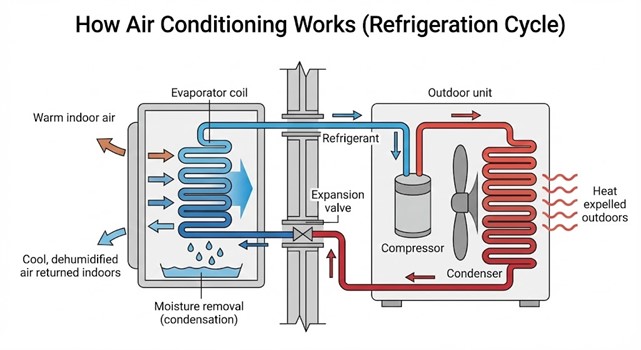
Air conditioning cools and dehumidifies air by circulating refrigerant through a closed refrigeration cycle and expelling heat outdoors.
Key features of air conditioning
- Uses refrigerant and compressors
- Recirculates indoor air through filters
- Actively reduces humidity
- Performs well in sealed or enclosed spaces
Air conditioning systems usually require condensate management, either via a collection tank or a drain line.
Key Differences at a Glance
| Feature | Evaporative Cooler | Air Conditioning |
| Cooling method | Water evaporation | Refrigeration cycle |
| Humidity impact | Increases humidity | Reduces humidity |
| Air source | Fresh outside air | Recirculated indoor air |
| Energy use | Lower electricity use | Higher electricity use |
| Climate suitability | Hot, dry climates | All climates (effective in high humidity) |
| Ventilation required | Yes (Open doors/windows) | No (Sealed room) |
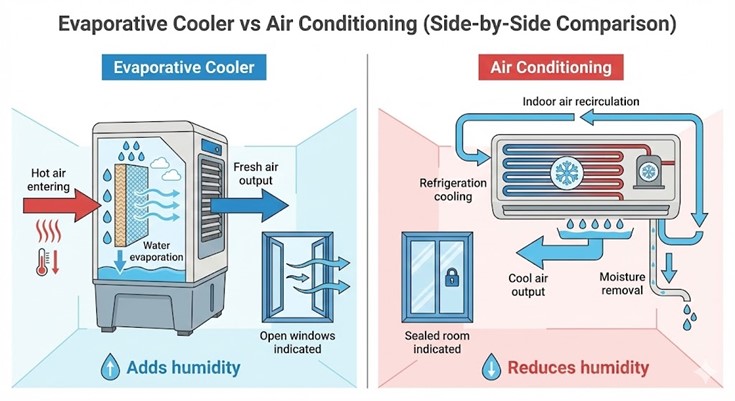
A visual comparison showing how evaporative coolers rely on water evaporation and ventilation, while air conditioning systems use refrigeration to remove heat and moisture in sealed spaces.
Which System Cools Better?
When it comes to cooling performance, air conditioning clearly delivers more consistent and reliable results.
Evaporative coolers can lower temperatures effectively in dry conditions, but air conditioning maintains a dependable temperature drop regardless of humidity. As humidity rises, evaporative cooling efficiency drops significantly because evaporation becomes less effective.
Energy Use & Costs
Evaporative Coolers:
Use significantly less electricity and have lower operating costs, but consume water.
Air Conditioning:
Uses more electricity and costs more to run, but provides consistent cooling regardless of outdoor humidity.
Air Quality and Comfort Considerations
Evaporative Coolers
- Continuously bring in fresh outdoor air
- Wash out some dust and particles via wet pads
- Add moisture to the air (may feel humid)
Air Conditioning
- Recirculates air through filtration systems
- Reduces indoor humidity (drier feel)
- Creates a sealed, controlled environment
When Evaporative Cooling Is the Right Choice
Best when the space is open, semi-open, or well ventilated… Common applications include warehouses, workshops, and outdoor work areas. For large industrial sites, heavy-duty units like a 48″ evaporative cooler or 36″ evaporative cooler are typically used, while smaller semi-open spots may only require a compact 60L unit.
When Air Conditioning Is the Better Option
Best when the space is fully enclosed, humidity control is required, precise temperature regulation is important, or windows and doors must remain closed.
Frequently Asked Questions
Does an evaporative cooler work with doors and windows closed?
No. Evaporative coolers require open windows or doors to release warm, moist air. In a sealed space, humidity builds up and cooling effectiveness drops.
Does evaporative cooling work in humid weather?
Not really. As humidity increases, evaporation slows significantly, making evaporative cooling much less effective.
Is evaporative cooling cheaper to run than air conditioning?
Generally, yes. Evaporative cooling uses less electricity, although it does consume water.
Does air conditioning reduce humidity?
Yes. Removing moisture from the air is a core function of air conditioning.
How much water does an evaporative cooler use?
Depending on the unit size and the heat, most commercial units use between 10 to 25 litres of water per hour. While there is a water cost, the electricity savings (up to 80% less than AC) usually make it the cheaper overall option.
Which system is better for server rooms or electronics?
Air conditioning is the only choice for server rooms. Electronics require a dry environment. Evaporative coolers add moisture to the air, which can lead to condensation and damage to sensitive hardware.
Can I use an air conditioner in an open warehouse or marquee?
It is not recommended. Air conditioners work by recirculating and cooling the same air in a sealed room. In open-air or semi-open environments, the cooled air escapes immediately. For these spaces, evaporative cooling is far more effective.
Final Takeaway
In simple terms, evaporative coolers cool air through water evaporation, while air conditioners cool air by mechanically removing heat and moisture.
The right choice depends on climate, ventilation, enclosure, and how much temperature and humidity control you need.
-
If you’re comparing evaporative cooling with portable air conditioners for temporary or hire-based cooling, see our guide here.
→ https://www.aircon.com.au/evaporative-cooler-vs-portable-air-conditioner/ -
For industrial worksite ventilation needs, you might also want to compare evaporative coolers with industrial fans here.
→ https://www.aircon.com.au/evaporative-cooler-vs-industrial-fan/